
ISO/IEC 27001 and ISMS Overview: A Complete Beginner's Guide (2022 Version Explained)
What is ISO/IEC 27001 and how does an ISMS work? A simple guide to the 2022 standard: clauses 4–10, the 93 Annex A controls, the certification process, benefits, and career opportunities in GRC.
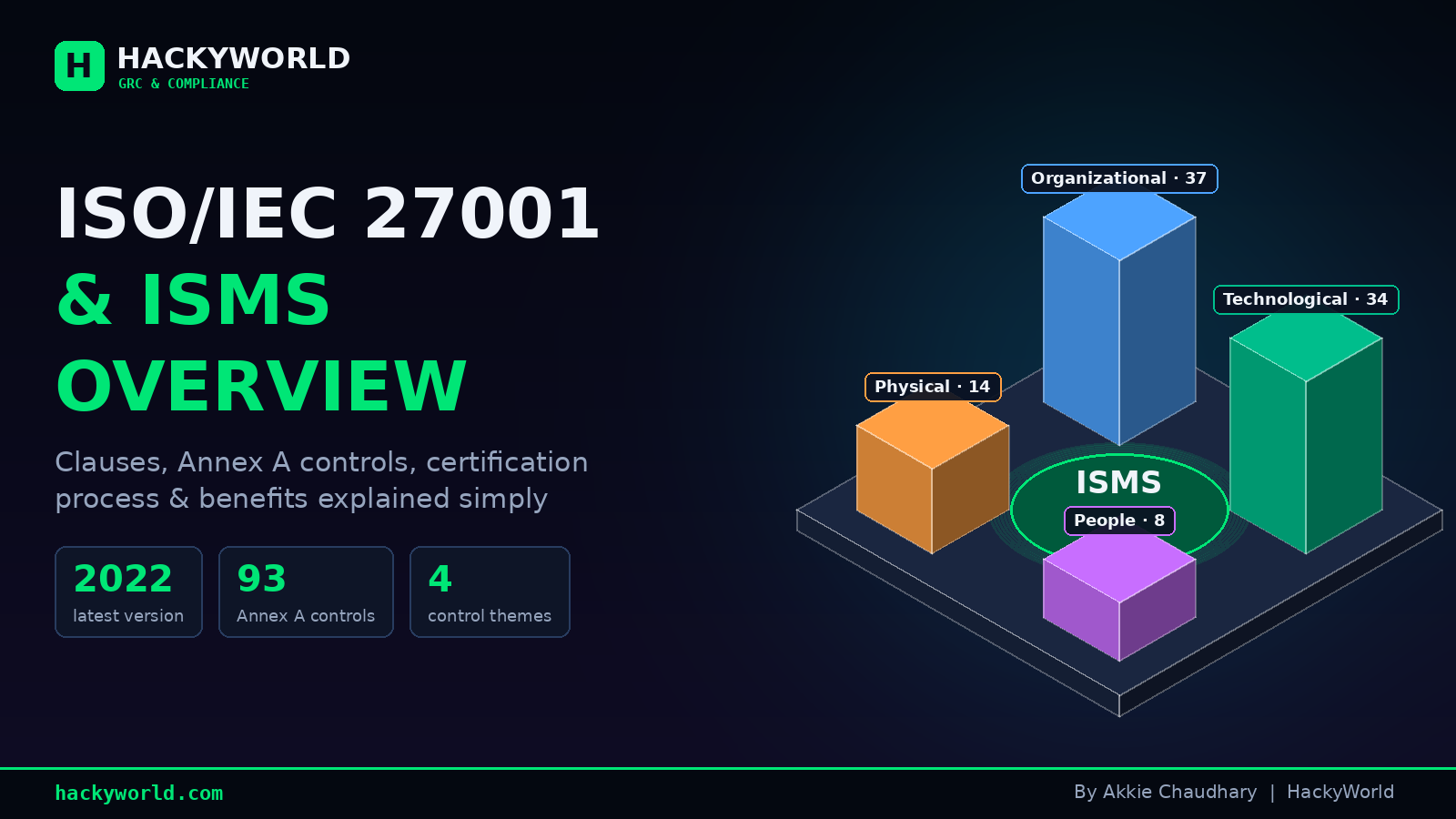
Quick answer: ISO/IEC 27001 is the world's best-known international standard for information security. It tells an organisation how to build, run and keep improving an ISMS (Information Security Management System): a structured set of policies, processes, people and controls that protect information. The current version is ISO/IEC 27001:2022, which has 93 security controls grouped into 4 themes.
What is an ISMS?
An Information Security Management System (ISMS) is not a software tool or a firewall. It is a management system: a planned, documented way of handling information security across the whole organisation.
An ISMS answers questions like:
- What information do we have, and where is it stored?
- What could go wrong (risks), and how bad would it be?
- Which controls do we use to reduce those risks?
- Who is responsible for what?
- How do we check that it's working, and improve it over time?
The goal of an ISMS is to protect the three pillars of information security, known as the CIA triad:
- Confidentiality: only authorised people can access information
- Integrity: information stays accurate and is not changed without permission
- Availability: information and systems are available when needed
What is ISO/IEC 27001?
ISO/IEC 27001 is the international standard that defines the requirements for an ISMS. It is published jointly by ISO (International Organization for Standardization) and IEC (International Electrotechnical Commission).
Key points:
- It applies to any organisation, of any size, in any industry: startups, banks, hospitals, IT companies, government bodies and more.
- Organisations can get certified by an accredited certification body to prove they meet the standard.
- It is risk-based: you choose controls based on the risks your organisation actually faces, not a one-size-fits-all checklist.
The current version: ISO/IEC 27001:2022
The latest version, ISO/IEC 27001:2022, was published in October 2022 with a new title: Information security, cybersecurity and privacy protection. It replaced the 2013 version, and the transition period for organisations certified to the old version ended on 31 October 2025. Today, all certifications are done against the 2022 version.
The biggest change was in Annex A: the controls were reorganised from 114 controls in 14 domains down to 93 controls in 4 themes, including 11 brand-new controls. A small amendment in 2024 also added climate change considerations to the standard.
ISO 27001 vs ISO 27002: what's the difference?
- ISO/IEC 27001 says what you must do. It contains the requirements, and it is the standard you get certified against.
- ISO/IEC 27002 explains how to implement each control. It is a guidance document with detailed advice.
Think of 27001 as the exam syllabus and 27002 as the textbook.
The structure of ISO/IEC 27001
The standard has two main parts: Clauses 4–10 (the mandatory ISMS requirements) and Annex A (the list of security controls).
Clauses 4–10: the core ISMS requirements
Clauses 0–3 are introductory (scope, references, terms). The real requirements start at Clause 4:
| Clause | Name | What it covers |
|---|---|---|
| 4 | Context of the organisation | Internal and external issues, interested parties, ISMS scope |
| 5 | Leadership | Top management commitment, information security policy, roles and responsibilities |
| 6 | Planning | Risk assessment, risk treatment, security objectives, planning changes |
| 7 | Support | Resources, competence, awareness, communication, documented information |
| 8 | Operation | Carrying out risk assessments and risk treatment plans |
| 9 | Performance evaluation | Monitoring, measurement, internal audit, management review |
| 10 | Improvement | Nonconformities, corrective actions, continual improvement |
All of these clauses are mandatory for certification.
The PDCA cycle
ISO 27001 follows the Plan–Do–Check–Act (PDCA) cycle of continual improvement:
- Plan: understand the context, assess risks, set objectives (Clauses 4–6)
- Do: implement controls and processes (Clauses 7–8)
- Check: monitor, measure and audit (Clause 9)
- Act: fix problems and keep improving (Clause 10)
An ISMS is never "finished". It keeps improving in a loop.
Annex A: the 93 controls in 4 themes
| Theme | Number of controls | Examples |
|---|---|---|
| Organizational controls (A.5) | 37 | Information security policies, asset inventory, access control, supplier security, incident management, threat intelligence |
| People controls (A.6) | 8 | Screening, security awareness training, disciplinary process, remote working, confidentiality agreements |
| Physical controls (A.7) | 14 | Secure areas, entry controls, clear desk and clear screen, equipment protection, physical security monitoring |
| Technological controls (A.8) | 34 | Endpoint security, privileged access, malware protection, backups, logging, monitoring, secure coding, data leakage prevention |
Some of the 11 new controls in the 2022 version:
- Threat intelligence
- Information security for use of cloud services
- ICT readiness for business continuity
- Physical security monitoring
- Configuration management
- Information deletion
- Data masking
- Data leakage prevention
- Monitoring activities
- Web filtering
- Secure coding
Important: you don't have to implement all 93 controls blindly. You select the controls that fit your risks, and you justify every decision in a key document called the Statement of Applicability (SoA).
How to implement an ISMS: step by step
- Get management support: leadership must commit resources and set the direction.
- Define the scope: decide which locations, teams, systems and processes the ISMS covers.
- Write the information security policy: a high-level statement of your security goals.
- Identify your assets: list the information, systems, people and suppliers that matter.
- Do a risk assessment: identify threats and vulnerabilities, and rate the likelihood and impact of each risk.
- Plan risk treatment: decide whether to reduce, avoid, transfer or accept each risk.
- Prepare the Statement of Applicability (SoA): list the Annex A controls you apply, and explain why you excluded any.
- Implement the controls: put policies, technical tools and processes in place.
- Train your people: security awareness is essential, because most incidents involve human error.
- Monitor and measure: track your security objectives and key metrics.
- Run an internal audit: check whether the ISMS meets the standard and is working.
- Hold a management review: leadership reviews results and approves improvements.
The ISO 27001 certification process
Certification is done by an accredited, independent certification body. The usual process looks like this:
- Stage 1 audit (documentation review): the auditor checks your ISMS documents, scope, policies, risk assessment and SoA to see if you are ready.
- Stage 2 audit (implementation audit): the auditor checks that your controls and processes are actually working in practice, through interviews, evidence and observation.
- Certification: if no major nonconformities are found, the certificate is issued, usually valid for three years.
- Surveillance audits: smaller audits are held, typically every year, to make sure the ISMS is being maintained.
- Recertification: a full audit is carried out at the end of the three-year cycle.
Benefits of ISO 27001 certification
- Builds customer trust: proof that you take data protection seriously.
- Wins more business: many large clients and government tenders require ISO 27001.
- Reduces the risk of breaches: a structured approach finds and fixes weak spots.
- Supports legal compliance: helps meet data protection laws like India's DPDP Act, and the GDPR for European clients.
- Clarifies roles: everyone knows their security responsibilities.
- Builds a culture of continual improvement.
Common mistakes organisations make
- Treating ISO 27001 as a "paperwork project" instead of real security
- Copying generic policy templates that don't match how the business actually works
- Making the scope too broad (or too narrow) at the start
- Skipping a proper risk assessment
- No security awareness training for staff
- Forgetting the ISMS after certification until the next audit
Career opportunities in ISO 27001 and GRC
ISO 27001 knowledge opens doors to GRC (Governance, Risk and Compliance) careers, which are among the most in-demand non-coding roles in cybersecurity:
- GRC / Compliance Analyst
- ISMS Implementer or Consultant
- Information Security Risk Analyst
- Internal Auditor
- ISO 27001 Lead Auditor
- Information Security Manager / CISO (with experience)
Popular certifications include ISO/IEC 27001 Lead Implementer and ISO/IEC 27001 Lead Auditor.
To see how GRC fits into the wider security field, read our guide on cybersecurity career opportunities.
Final thoughts
ISO/IEC 27001 is not just a certificate on the wall. It is a practical framework for managing information security in a structured, risk-based and continually improving way. Whether you're a business looking to win client trust or a student building a career in cybersecurity, understanding ISO 27001 and how an ISMS works is a valuable skill.
Learn ISO 27001, ISMS and GRC with HackyWorld. Explore our cybersecurity courses and live classes. Need help implementing an ISMS or preparing for an audit? Check out our services or contact us. Read more guides on the HackyWorld blog.
Written by Akkie Chaudhary, Founder of HackyWorld.