
SpaceX Makes History: Starship Upper Stage Caught by Launch Tower for the First Time on Flight 15
On Starship Flight 15, SpaceX caught its Starship upper stage with the launch tower's "chopstick" arms for the first time after 22 hours and 14 orbits. The booster was lost. Here's what happened and why it matters.
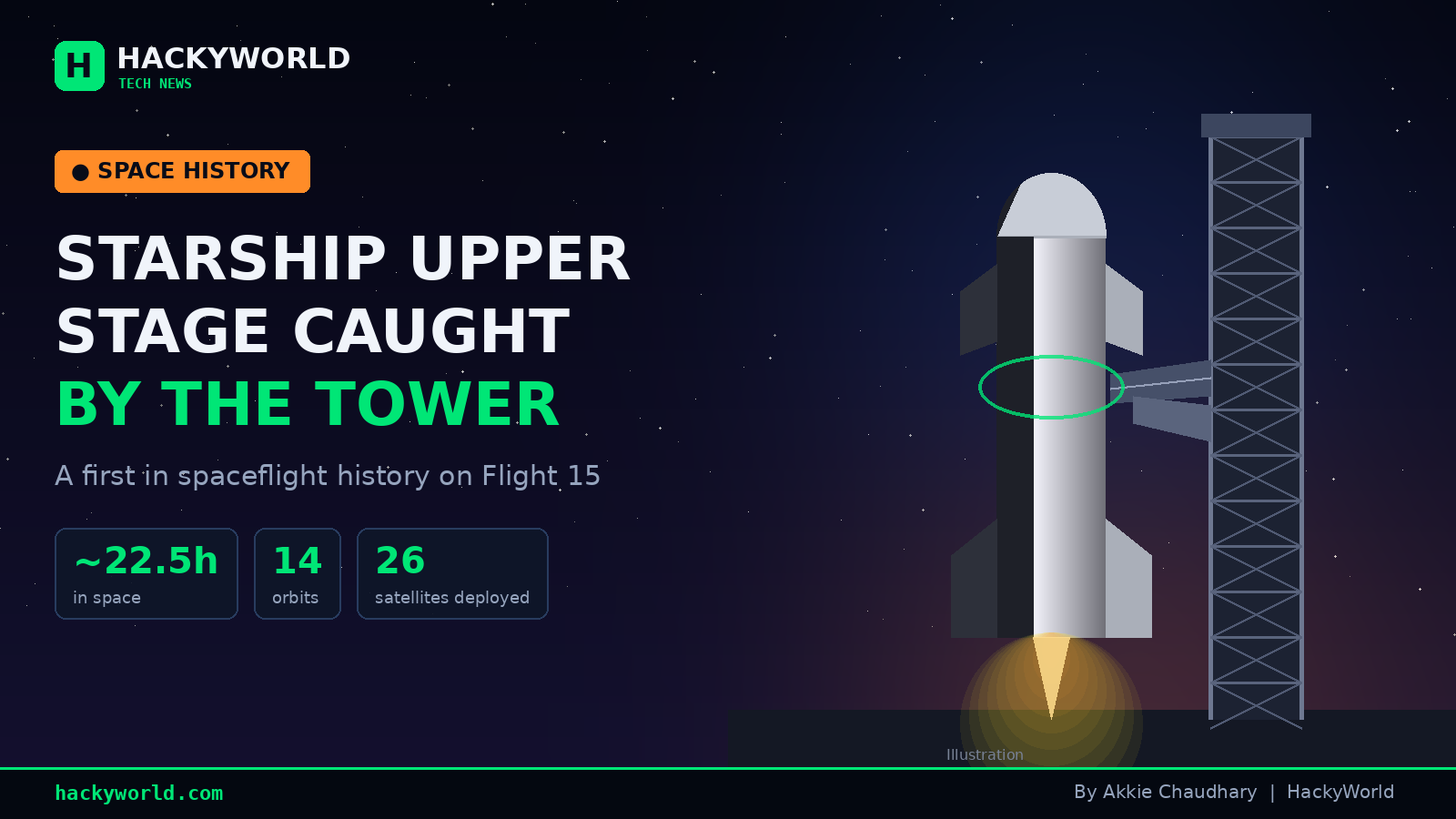
TL;DR: On Starship Flight 15, SpaceX did something no one in spaceflight history had done before. It caught an orbital rocket's upper stage with its launch tower's giant mechanical arms after the vehicle returned from orbit. Ship 42 spent about 22.5 hours in space, completed 14 orbits and deployed 26 Starlink V3 satellites before landing in the tower's arms at Starbase, Texas. The Super Heavy booster, however, called off its own catch attempt and was lost in the Gulf of Mexico.
What happened on Starship Flight 15
Flight 15 lifted off from Starbase, Texas, at around 4:47 p.m. local time (CST) on Friday, 13 November 2026. The goal was hugely ambitious: catch both stages of the rocket back at the launch site, something no orbital launch system has ever done.
The flight had two parts, and they ended very differently.
The booster: catch called off
SpaceX has caught its Super Heavy boosters with the tower's "chopstick" arms several times before, so a booster catch was not new. But this time, Booster 22 cut its return manoeuvre short soon after launch and diverted away from the tower. Instead of being caught, it came down in the Gulf of Mexico and was lost.
The full reason is still being analysed. Early reports point to the booster ending its return burn early, which made a safe catch attempt impossible.
The ship: a historic first
The upper stage, Ship 42, had a near-perfect mission:
- It reached orbit and deployed 26 Starlink V3 satellites
- Three of those satellites carried cameras to photograph the ship's heat shield, so engineers could check it was in good shape before bringing it home
- It then stayed in space for roughly 22.5 hours, completing 14 orbits, while flight controllers monitored its systems
- SpaceX had planned several "exit points" during the flight to send the ship to an ocean landing instead, in case anything looked wrong. None were needed.
On Saturday, 14 November, Ship 42 came back through the atmosphere, flew over land towards Starbase, flipped upright, fired its Raptor engines to slow down, and hovered beside the tower. The tower's arms closed around it and caught the ship in mid-air, leaving it hanging above the launch mount.
It was the first time a Starship upper stage had ever been caught by the tower.
Why catching the ship is such a big deal
1. It's the missing half of full reusability
Rockets are expensive mainly because most of them are thrown away after one flight. SpaceX already reuses Falcon 9 boosters, but the upper stage of almost every rocket in history has been discarded.
Catching Starship's upper stage proves the second half of the reuse puzzle is possible. If both stages can be caught and flown again, the cost of reaching space could drop dramatically, a bit like the difference between throwing away an aeroplane after every trip and refuelling it at the gate.
2. Landing from orbit is much harder than landing a booster
A booster comes back from the edge of space at relatively low speed. An upper stage comes back from orbit, at enormous speed, and must survive extreme heat during reentry. It then has to slow down and hit a precise spot next to a tower. Doing that after 14 orbits is a major engineering milestone.
3. It matters for the Moon and Mars
Starship is central to future crewed missions to the Moon, and SpaceX's long-term plan for Mars depends on fully reusable vehicles that can be refuelled and flown again quickly. A ship that can be caught and reused is a key step on that path.
What's next
SpaceX now has two jobs:
- Find out what went wrong with Booster 22 and fix it, so future flights can attempt a catch of both stages
- Inspect Ship 42 after its return, to learn how well the heat shield and structure survived a long orbital flight
The first full recovery of both stages of an orbital rocket is still waiting to happen. After Flight 15, it looks closer than ever.
The tech behind it: software, sensors and security
For tech learners, Flight 15 is also a reminder of how much modern spaceflight depends on software, sensors and secure communications. Every step, from deciding whether the booster should attempt a catch to guiding a 50-metre ship into a pair of mechanical arms, relies on real-time data, automated decision-making and reliable command links between the vehicle and the ground.
As satellite networks like Starlink grow, so does the importance of space cybersecurity: protecting satellites, ground stations and the data links between them from interference and attack. It's one of the most exciting emerging areas in security.
If you want to build the skills behind tech like this, from networking and Linux to cybersecurity fundamentals, explore our cybersecurity courses or join a live class at HackyWorld.
Stay updated with the latest in tech, space and cybersecurity on the HackyWorld blog. Have a question or story idea? Contact us.
Written by Akkie Chaudhary, Founder of HackyWorld.