Cyber security Careers: Where the Opportunities Are and How to Get In
Explore the most in-demand cybersecurity careers, the skills and certifications behind them, and a practical six-step roadmap to land your first security job.
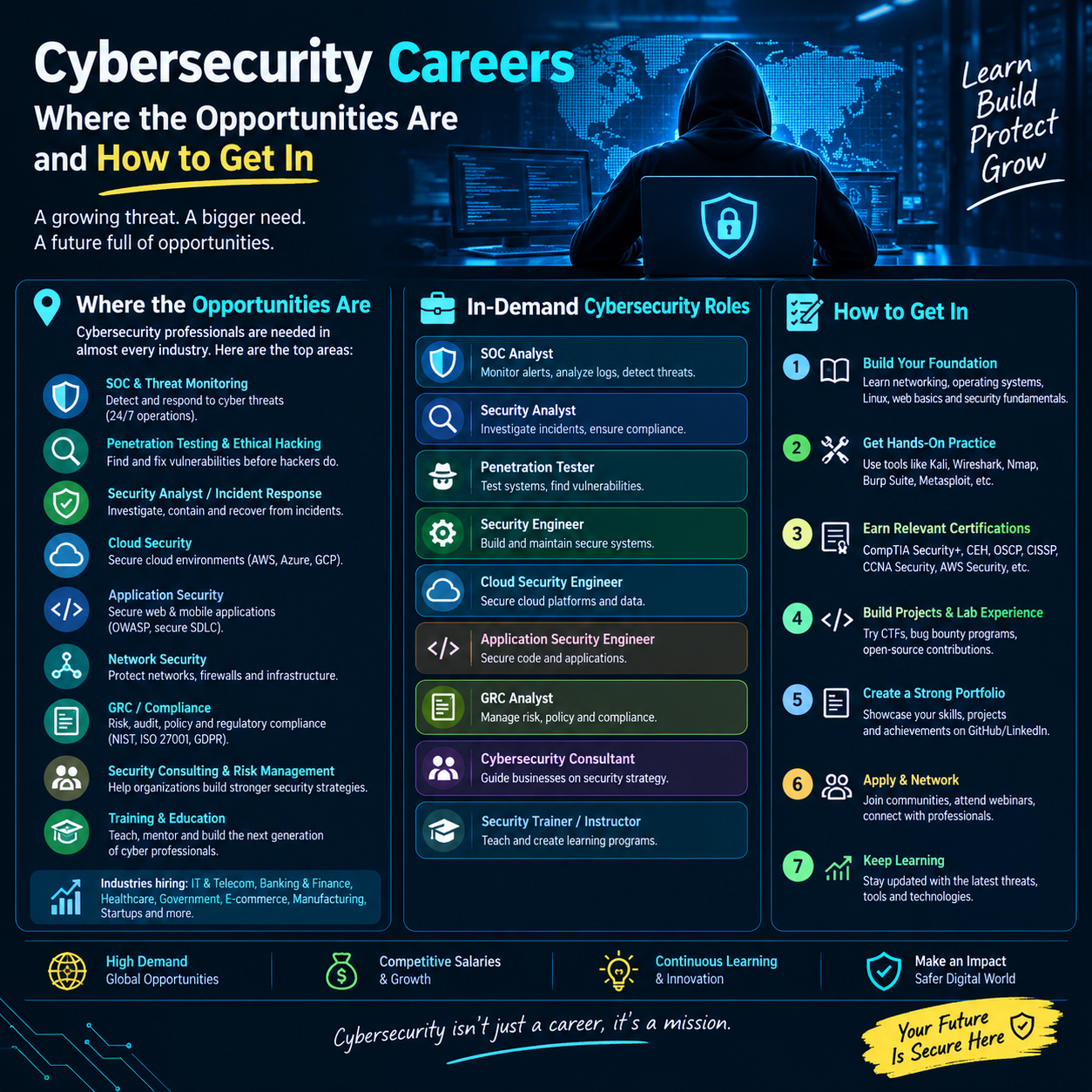
Every company that stores customer data, runs software or takes payments is a target. That is why cybersecurity remains one of the few technology fields where demand for skilled people keeps outrunning supply. Workforce studies have repeatedly pointed to a global shortfall of security professionals, and the gap shows up in how quickly good candidates get hired and in how many entry points the field now offers.
This guide covers the roles worth knowing, the skills and certifications that matter, and a realistic path to your first security job.
Why cybersecurity is a strong career choice
Three forces keep pushing demand up:
- Attacks are more frequent and more professional. Ransomware groups now run like businesses.
- Regulation is tightening, so privacy and compliance need dedicated staff.
- Cloud and AI adoption creates new attack surface faster than teams can secure it.
Security is also not one job. It spans technical, analytical, creative and managerial work, so people from very different backgrounds can find a fit.
The main career paths
- SOC analyst: Monitors alerts, investigates suspicious activity and escalates real incidents. The most common entry point and excellent training for everything else.
- Penetration tester / red teamer: Legally attacks systems, applications and people to find weaknesses before criminals do. Rewards curiosity, persistence and strong report writing.
- Incident responder / forensics analyst: Contains breaches, works out what happened and helps the organisation recover. Calm thinking under pressure is the core skill.
- Cloud security engineer: Secures AWS, Azure or Google Cloud environments, covering identity, configuration, network controls and automation. One of the fastest-growing specialisations.
- Application security engineer: Works with developers to find and fix flaws in code, build pipelines and APIs. Suits people who already like programming.
- Threat intelligence analyst: Studies attackers, their tools and their targets, then turns that research into practical defences.
- GRC analyst (governance, risk and compliance): Maps controls to standards and laws, runs risk assessments and prepares for audits. A strong route for people with business, legal or audit backgrounds.
- Security architect and CISO: Senior roles that design security strategy and lead teams. They come with experience and the ability to explain risk in business terms.
Skills employers look for
- Networking basics: TCP/IP, DNS, HTTP, firewalls and how traffic moves.
- Operating systems: Comfort with Linux and Windows, especially the command line and logs.
- Scripting: Python and Bash for automation and data analysis.
- Security fundamentals: Authentication, encryption, common attack types and the MITRE ATT&CK framework.
- Communication: Clear writing and the ability to explain a technical problem to a non-technical manager. This is the most underrated skill in the field.
Certifications: what they are for
Certifications will not replace hands-on ability, but they help you pass resume filters and give your learning structure.
- Starting out: CompTIA Security+, ISC2 Certified in Cybersecurity
- Defensive track: CompTIA CySA+, Blue Team Level 1, GIAC certifications
- Offensive track: eJPT, PNPT, OSCP
- Cloud and GRC: AWS or Azure security certifications, CCSP, CISA
- Senior level: CISSP, CISM
A practical roadmap to your first role
- Build the base. Learn networking, Linux and basic Python. Free courses and documentation are enough to start.
- Learn by doing. Practise on legal platforms such as TryHackMe and Hack The Box, and build a home lab with virtual machines.
- Pick a direction. After a few months of exploring, choose a track (defence, offence, cloud or GRC) and go deeper.
- Prove it publicly. Write up your lab work, share scripts or detection rules on GitHub, and blog about what you learn. A blog is a portfolio.
- Earn one fitting certification. Match it to your target role rather than collecting badges.
- Apply widely. Look at help desk, system administration, SOC and junior analyst postings. Many security professionals started in general IT.
Only test systems you own or have written permission to test. Unauthorised scanning or hacking is illegal and can end a career before it starts.
Trends shaping the next few years
AI is changing both sides. Attackers use it for convincing phishing and faster reconnaissance, while defenders use it to triage alerts. People who know how to secure AI systems themselves, including data leakage, prompt injection and model abuse, will be especially valuable. Cloud and identity security keep growing, and operational technology and IoT security are opening roles in manufacturing, energy and healthcare.
Final thoughts
You do not need a perfect degree or a hacker's reputation to start. You need steady curiosity, a habit of practising and a willingness to keep learning, because the field never stops moving. Pick one small step today, such as setting up a lab or finishing a first room on a practice platform, and build from there.